Ten Italian wines made the 100 most exciting wines list from Wine Spectator and I'm very pleased to see Barolo (and therefore nebbiolo) taking out the top spots. In age when Amarone seems to be all the rage, it's good to see something more subtle and classy being appreciated from Italy.
Pio Cesare has made number six overall and is the top Italian drop on the list. Given that, I suspect the list is very much based on the most exciting wines available on the US market; and while I think they could probably get most Barolo there, Pio Cesare could be knocked out of that position by other Barolos, too.
Off the high brow talk of the wine that made the list, the other great thing is that a lot of the wine is not particularly expensive. In fact, all the wines are estimated at being below 100 USD apart from one. The list below was kindly compiled by Blog from Italy.
So, the Top Ten Italian Wines in 2008 according to Wine Spectator are:
According to Wine Spectator, these were the most exciting Italian wines of 2008:
1. Pio Cesare Barolo 2004 ($62) – Position in Wine Spectator world ranking: 6
2. Aldo & Riccardo Seghesio Barolo Vigneto La Villa 2004 ($65) – Position in world ranking: 14
3. Sette Ponti Toscana Oreno 2006 ($110) – Position in world ranking: 15
4. Avignonesi Vino Nobile di Montepulciano Grandi Annate Riserva 2004 ($63) – Position in world ranking: 22
5. La Massa Toscana 2006 ($28) – Position in Wine Spectator world ranking: 31
6. Firriato Nero d’Avola-Syrah Sicilia Santagostino Baglio Soria 2006 ($28) – Position in Wine Spectator world ranking: 50
7. Fattoria di Felsina Chianti Classico Berardenga 2006 ($17) – Position in Wine Spectator world ranking: 51
8. Attems Pinot Grigio Collio 2007 ($19) – Position in world ranking: 70
9. Suavia Soave Classico 2007 ($19) – Position in world ranking: 75
10. Marchesi de’ Frescobaldi Chianti Rufina Castello di Nipozzano Riserva 2005 ($25) - Position in world ranking: 76
Wednesday, September 23, 2009


Sunday, September 6, 2009
Protero wines is top quality Australian nebbiolo

For what it’s worth, I have endowed my personal and unofficial “best Australian nebbiolo” trophy to Protero wines from the Adelaide Hills, tasted at the Wine Focus Australia event in Sydney, where I also met part of the team from Protero.
I get the impression the passion for “geological epochs” (dare I mention “terroir” on Australian soil?) is a genuine one, with an almost embarrassing enthusiasm born of truthful commitment to what the small winery is trying to achieve.
I hope we never see Protero become too boutique or too exclusive (read “up themselves”), as is the fate of many hobby wineries attempting to carve niches. So far there doesn’t seem to be much danger as with a professional team, Protero have every right to hold the conviction that they make very good wine that deserves a label of quality. They have a commitment to organic vineyard principles, and are currently waiting on their certification set to come through in November this year.
And whether it’s the organic principles that make what’s in the glass really come alive, I am happy to say that the Protero nebbiolo is one of the best Australian nebbiolo’s I’ve ever had.
The Protero nebbiolo is earthy and dusky on the nose, with forest berry characters and lovely underbrush qualities. It has a great whack of fruit-based tannins, which I love and which embody the personality of nebbiolo; these tannins are also under elegant control and not stalky or green. Overall the wine really sits in the mouth, with good structure and acidity, while you get to chew on the tannins a little while longer.
The Protero nebbiolo will certainly cellar marvellously, and if this is what Protero is making after only about eight years of a vineyard with their 2005 nebbiolo vintage, I really can’t wait to see what they produce in the future. One to watch. Get your Protero wines in Sydney from Annandale cellars.
Friday, August 7, 2009
Barbaresco event in Piedmont

Barolo is not Piedmont's only great wine, with Barbaresco right up there, in my opinion, or running a close second depending on your tastes. If you need more of an introduction to Barbaresco, Piedmont is hosting the "Piacere, Barbaresco" event from September 4th to 7th, with a focus on getting to know this wine.
Barbaresco hails from the Langhe area of Piedmont and like its more famous brother, Barolo, also derives from nebbiolo grapes. It is made in three sub-zones of Barbaresco, Treiso and Neive and is truly an exercise in individual expression.
It's unclear whether you need an invitation to this event or not, but you could probably swing yourself one if you're a nice enough person. It seems that it's aimed at the general public though, and not the press which is probably quite refreshing.
The event program includes a tasting free-for-all in Treiso at the council gym, open from the 5th to the 7th from 10am to 8pm. This is the main site of the event, and from here mini buses are organised to take visitors to the various events held around the Langhe region.
There is a tour of the Barbaresco "crus", visits to the vineyards, dinners and other dining events, all with different prices. The tasting bar costs 15 euros entry. For the full program, see the Enoteca del Barbaresco site.
Source | Esalazioni Etiliche
Wednesday, July 29, 2009
Italy to give top wine to visiting diplomats via Premium Brands
I'm not sure that giving away wine such as Antinori, Biondi Santi, Donnafugata and Pio Cesare is necessarily the right move for the Italian government with Prime Minister Berlusconi under siege in the international press; it might come off as an underhanded attempt to gain favour.
As part of its "Made in Italy" brand, celebrating the best in Italian brands, manufacturing and products, the Italian government will give visiting dignitaries a case of Italy's best wine. What wine will be included in the cherry wood case is anyone's guess, but it is said to be "among the most prestigious labels of the country" and presided over by no-one less than Piero Antinori.
The initiative comes from the Minster of Foreign Affairs with a statement saying that wine is one of the best representatives of Italy and the opportunity to promote the Italian culture and language has not been fully explored. The project is in collaboration with the 'Istituto del vino italiano di qualità Grandi Marchi' (the Institute of Fine Italian Wine: Premium Brands, site in English), which manages 17 of Italy's best wine brands.
According to the Minister for Foreign Affairs, it is to Berlusconi we "owe the new direction of Italian diplomacy at the service of the development of the country". I fail to see the link between making prestigious wine a gift to travelling diplomats and the overall promotion of Italian language and culture.
While I've got no problem with the Institute of Premium Brands, I have some concern about it lending its services to the current Italian government, under the circumstances. The Insitute's mission statement (below) would suggest they could re-think the strategy of giving their wine, not as a contribution to Italian culture, but to a government initiative, lest it be seen as an endorsement of the government or worse, an attempt to buy the favour of international visitors.
The Institute of Fine Italian Wines - Premium Brands is the result of the determination and enthusiasm of some of the most important Italian wineries to promote the culture and commercialisation of Italian high quality wine on world markets.
It unites families and brands which characterise the Italian wine-making tradition - each one extremely innovative yet highly representative of the production of their region.
Each winery is defined by the high standards of its products and brand image at national and international levels.
They are families and brands which encapsulate the identity of Italian wine which is synonymous with quality and style throughout the world.
The member wineries strongly adhere to tradition whilst constantly updating their style and production methods to meet the needs of evolving markets. Both of these aspects are important characteristics of Italian winemaking and are the key to the success of Italian wine on International markets.
The Institute aims to:
* give direction and incisiveness to the development of quality Italian wine and to the brands which express this on world markets
* organise and develop training and educational activities contributing to the promotion of Italian wine culture in the world
* be an authority and reference point for high quality Italian wine
Source | Sommelier.it
As part of its "Made in Italy" brand, celebrating the best in Italian brands, manufacturing and products, the Italian government will give visiting dignitaries a case of Italy's best wine. What wine will be included in the cherry wood case is anyone's guess, but it is said to be "among the most prestigious labels of the country" and presided over by no-one less than Piero Antinori.
The initiative comes from the Minster of Foreign Affairs with a statement saying that wine is one of the best representatives of Italy and the opportunity to promote the Italian culture and language has not been fully explored. The project is in collaboration with the 'Istituto del vino italiano di qualità Grandi Marchi' (the Institute of Fine Italian Wine: Premium Brands, site in English), which manages 17 of Italy's best wine brands.
According to the Minister for Foreign Affairs, it is to Berlusconi we "owe the new direction of Italian diplomacy at the service of the development of the country". I fail to see the link between making prestigious wine a gift to travelling diplomats and the overall promotion of Italian language and culture.
While I've got no problem with the Institute of Premium Brands, I have some concern about it lending its services to the current Italian government, under the circumstances. The Insitute's mission statement (below) would suggest they could re-think the strategy of giving their wine, not as a contribution to Italian culture, but to a government initiative, lest it be seen as an endorsement of the government or worse, an attempt to buy the favour of international visitors.
The Institute of Fine Italian Wines - Premium Brands is the result of the determination and enthusiasm of some of the most important Italian wineries to promote the culture and commercialisation of Italian high quality wine on world markets.
It unites families and brands which characterise the Italian wine-making tradition - each one extremely innovative yet highly representative of the production of their region.
Each winery is defined by the high standards of its products and brand image at national and international levels.
They are families and brands which encapsulate the identity of Italian wine which is synonymous with quality and style throughout the world.
The member wineries strongly adhere to tradition whilst constantly updating their style and production methods to meet the needs of evolving markets. Both of these aspects are important characteristics of Italian winemaking and are the key to the success of Italian wine on International markets.
The Institute aims to:
* give direction and incisiveness to the development of quality Italian wine and to the brands which express this on world markets
* organise and develop training and educational activities contributing to the promotion of Italian wine culture in the world
* be an authority and reference point for high quality Italian wine
Source | Sommelier.it
Sunday, July 26, 2009
Register for wine professionals proposed in Italy

A member of the Italian Senate has proposed a bill to create an official register of wine professionals in Italy, saying that current requirements are unclear, and suggesting that the profession is full of amateurs.
Senator Pierfrancesco Gamba has said the register is required to: "better define the requisites to become a professional sommelier, a category which today sees people call themselves experts just because they have taken wine tasting courses".
The Italian Sommeliers Association (AIS) together with Italian Federation of Sommeliers, Hotel and Restaurant Operators (FISAR) has opposed the making of a register, stating that it's being put in place for private interest groups, and that their diploma courses provide the training needed to become an expert.
I am ambivalent about the proposed bill, and having completed the AIS courses myself I neither consider myself an expect, nor 'just' a wine taster. The Italians are probably creating more work and bureaucracy for themselves than necessary (they seem to very good at that) and I should imagine that a person's expertise and professionalism would be judged by those in the industry, rather than the existence of any register. I completed what are quite rigorous courses from AIS, but I wouldn't purport to be a professional sommelier in the same way that I wouldn't pretend to be one because my name appeared on a register.
Source | VinoWire
Wine blogging vs wine writing and the 2009 wine bloggers conference

Tom Wark from Fermentation has been gearing up for the 2009 North American wine bloggers conference with many a post on the activity of wine blogging, making me wonder if he is temporarily indulging in the 'navel gazing' essential to the blogger character.
He makes a couple of interesting points about the differences and similarities between wine blogging and writing, which are not just confined to the world of wine but to journalism in general and the use of new media.
Wark does state that one of the key characteristics of wine writing is to educate readers and wine lovers (and he hopes for a day when the sniping between writers and bloggers will end). He left out one thing though, about wine blogging, which is important to me and my blog: educating myself.
His thoughts are as follows:
Wine Bloggers, however, should recognize that those writers who make their way into traditional media outlets have in fact done so by proving themselves. I would argue that the vast majority of writers working in mainstream wine media do have more experience, more perspective, a deeper well of wine knowledge and more at stake in their writing than most wine bloggers. They have been plucked by experienced editors at money-making enterprises to represent the enterprise and provide their customers with high quality content.
But those who write for mainstream media must understand that the new corps of wine bloggers represent something important. They tend to possess a passion for wine and communicating that is second to none in the wine industry. They tend to be uber-champions of the average wine drinker. And if they seem to be navel gazers at times it's because they recognize far better than the mainstream wine media that blogging and on-line content will revolutionize the way wine lovers educate themselves. And these wine bloggers believe they have responsibility to make this medium as meaningful as possible.
Thursday, July 23, 2009
Henschke Hill of Grace under screw cap

I wonder what my former colleagues at the wine investment fund would say to Henschke bottling its 2005 Hill of Grace under screw-cap. In fact, I probably know and the result would be Hill of Grace being struck off the list of fund options.
Not because it's Australian, or because it's not expensive enough, but because it has now descended to the screw-cap. This type of closure would, I suspect, be seen as denigrating to the wine and a likely confirmation that Hill of Grace was never worthy enough anyway.
The debate on screw-cap seems to go in circles, and with screw-cap being associated with cheap, easing drinking wines, most new world wines in Europe are labelled as such.
At a recent Pinot Noir seminar I attended in Italy, the international pinot evening saw more than one person turn their nose up at New Zealand pinots bottled under screw-cap. Only some more discerning drinkers were prepared to consider it viable, seeing the practical benefits and the commercial benefits, too.
I suspect with a Hill of Grace endorsement, the international market may slowly come to realise that screw-cap is a kind of quality control; a mark that a wine's quality is in tact, rather than an indication of cheap, un-ageable wines not destined for the cellar.
For more information and an interesting comparison on screw-cap and corks, complete with tasting notes, see The Age. Thanks to Ian from the OzWine group for the tip.
Tuesday, July 21, 2009
Brunello scandal investigation concludes

The results of the investigation into the Brunello scandal have been released, with 1.3 million litres of Brunello di Montalcino declassified from DOCG (Denominazione di Origine Controllata Garantita) to IGT (Indicazione Geografica Tipica).
In a more positive move, 5.4 million litres have been confirmed as conforming to the classification and hence have been released. The Brunello discipline rules that any wine bearing the Brunello di Montalcino name and the DOCG classification must be 100% sangiovese, with the original confiscation of the wine occurring due to accusations that varieties other than sangiovese had been used.
The original claim was made that the wine was modified to meet international, particularly US tastes, reducing the tannic nature of the sangiovese grape. Some high profile companies were involved, including names such as Antinori, Banfi, Frescobaldi and Argiano; and after a vote not to change the discpline, keeping the 100% sangiovese rule, charges to be laid are mostly of commercial fraud.
The other discplines of the area, including Rosso di Montalcino DOC and Chianti DOCG, also came under scrutiny, with the investigation involving the vintages from 2003 to 2007. 500,000 litres of Rosso di Montalcino have been de-classified to IGT and 150,000 litres of Chianti have also ben de-classified. 100,000 litres of IGT Toscana Rosso have been de-classified and are now destined to be distilled.
Source | Il Sole 24 Ore
Friday, June 12, 2009
Great Australian rosé: Cassegrain wines

I’ve been tasting an eclectic mix of wines since I’ve been back in Australia, though I’ll save some of the impressive ones for my posts on our mini-Mudgee tour and visits in Orange.
In a moment of rosé in the house, rare for us, we had to tip a bottle of 2006 Bloodwood Big Men in Tights down the sink, proving that rosés shouldn’t be kept for too long.
But in its place we had a lovely Cassegrain’s 2008 rosé, made from cabernet sauvignon grapes. This for me is wonderful rosé, refreshing enough, without that frustrating indecisive style when rosés aren’t sure if they wanted to be reds. The description on the label is about as accurate as you’ll get: poached rhubarb on the palate. This is like drinking a refreshing white with a little more weight and it was quite delightful.
Currently open this evening is the Cassegrain’s 2008 Fromenteau Reserve Chardonnay. It’s an elegant chardonnay, smooth but not too oaky. It has a fruity nose and to really enjoy its silkiness and full flavour, I recommend drinking not too cold. Out of the cellar should be fine.
If you haven’t tried any Cassegrain Wines, they’re worth the exploration, especially if you get to the cellar door. They have really friendly, knowledgeable staff who’ll take the time to give you the right introduction.
Friday, May 15, 2009
Italy's native wines: Vitigno Italia celebrates indigenous grape varieties
The Vitigno Italia event starts on Sunday in Naples, in a wine exhibition that showcases what we can describe as Italy’s “native wines”. Vitigno Italia is specifically dedicated to grape varieties from Italy, and should prove to be a fascinating event, to taste everything from Arneis to Aglianico, Zibibbo and back again.
Alternatively speaking, I am a particular fan of Italy’s southern grape varietals (otherwise I stick to nebbiolo which is an all-time favourite of mine). Impressive indigenous wines, particularly from Campania, include Greco di Tufo, falanghina, and aglianico, and moving further north Tuscany offers some great vermentino, though I also love Vermentino di Gallura from Sardinia.
In its 2009 Italy supplement, Decanter takes a look at Italy’s indigenous whites, saying that insipid Italian white wines have damaged the country’s reputation. Mark O’Halleron takes a look at some of the indigenous whites, saying that it is a reputation that, “on the basis of this tasting, Italy has been rather harshly lumbered with”.
I couldn’t agree more, and if the UK hasn’t got its hands on good Italian whites, and has only “unimaginative” Pinot Grigio or Soave on offer, more fool them. It doesn’t take much exploring in Italy to find some excellent whites, and some even more excellent native whites.
So here’s hoping that Vitigno Italia will be a real celebration; after all, Italy has the most incredible patrimony in terms of grape varieties, that makes it an exciting country to explore, via its wines.
P.S For a look at some interesting wine from Campania, take a look at Terredora: amazing Greco di Tufo, coda di volpe (I love this name for a grape: “the fox’s tail”) and Taurasi (aglianico).
Alternatively speaking, I am a particular fan of Italy’s southern grape varietals (otherwise I stick to nebbiolo which is an all-time favourite of mine). Impressive indigenous wines, particularly from Campania, include Greco di Tufo, falanghina, and aglianico, and moving further north Tuscany offers some great vermentino, though I also love Vermentino di Gallura from Sardinia.
In its 2009 Italy supplement, Decanter takes a look at Italy’s indigenous whites, saying that insipid Italian white wines have damaged the country’s reputation. Mark O’Halleron takes a look at some of the indigenous whites, saying that it is a reputation that, “on the basis of this tasting, Italy has been rather harshly lumbered with”.
I couldn’t agree more, and if the UK hasn’t got its hands on good Italian whites, and has only “unimaginative” Pinot Grigio or Soave on offer, more fool them. It doesn’t take much exploring in Italy to find some excellent whites, and some even more excellent native whites.
So here’s hoping that Vitigno Italia will be a real celebration; after all, Italy has the most incredible patrimony in terms of grape varieties, that makes it an exciting country to explore, via its wines.
P.S For a look at some interesting wine from Campania, take a look at Terredora: amazing Greco di Tufo, coda di volpe (I love this name for a grape: “the fox’s tail”) and Taurasi (aglianico).
Saturday, May 9, 2009
Restaurants in Verona: Antica Bottega dei Vini and the "Valpolicella Ripassso episode"
 We recently had a meal at the Antica Bottega dei Vini in Verona, set up as a restaurant, and wine and food shop in Verona’s centre. You can also find a Bottega del Vino in New York, remarkably similar in its style, though I’ve never eaten there, so that’s extent of my comments on the New York arm of the business.
I had previously eaten at the Bottega dei Vini in Verona a few years ago and as the experience was positive, I was keen to go back. I also wanted a slightly up-market restaurant as we had guests with us and it seemed the place we could impress a little while enjoying a good meal.
To say the visit was disappointing would be an exaggeration. We had a good meal, managed to navigate our way around the enormous wine list (more and less) and paid what we had expected for four people.
There were a couple of downfalls, though: our guests didn’t know much about Italian wine so ordering something “from the region” and then attempting to explain they were all native grapes, and not cabernet sauvignon, merlot or chardonnay was not easy.
We had a Valpolicella Ripasso as I was caught between choosing a classic wine (say a Bardolino Superiore) and something more geared toward new world, international tastes. The explanation got very long winded though, when I had to start at grape varieties, moving through what Amarone is, and then to Ripasso. Our guests, rightly so perhaps, had already lost interest.
I also made the error of not requesting advice from the wine waiter or sommelier, so we could have had something perhaps more adequate and exciting. In addition, I’ve decided any attempts to budget in a place like the Bottega Dei Vini is best left at the door. We spent 30 euros on the wine as it was, and it was one of the cheapest on the menu.
The major disappointment was that despite my intrepid navigating through the enormous wine list, the restaurant then didn’t even have the one I ordered. And so the head waiter or wine waiter said, “I don’t have that one, will this do?” and promptly plonked a different bottle on the table. He was not overly friendly towards my request of the vintage (two years younger than the previous bottle requested), and not knowing what to do, I accepted it.
The wine was okay, and I have no way of knowing whether the first bottle I had ordered was any better, but it’s a lesson in stock for the restaurant. There’s no point in having hundreds of labels on the list if then they’re not subsequently available. And a more elegant way of suggesting a second bottle would certainly have been appreciated.
The big problem came down to comparing the meal we had there at 236 euros, compared to the 100 euros for four people we spent at “Il cielo di Biancaneve” the night before: great food, friendly service, and a wine we liked better (still a Ripasso) at only 20 euros. Thoroughly recommended.
For more information (in Italian) on Valpolicella Ripasso, also known as "Baby Amarone" or "Super Valpolicella" see "Berevino" and "Tigulliovino".
Thursday, May 7, 2009
Wine making in the Valtellina: traditional nebbiolo from Bruno Leusciatti
 The Valtellina wine making region of Italy seems to be slowly splitting down two wine making styles: one is the traditional capturing of the nebbiolo character, and the other is making fatter, higher alcoholic wines that may appeal to new markets but that aren’t necessarily a reflection of the wine making tradition of the Valtellina.
I had the pleasure recently of meeting the wine maker of one of the traditional Valtellina nebbiolo styles, and his wine is truly worth the taste. Bruno Leusciatti is a humble man of the vineyards who has no pretension about making grand wines. His aim is to do the best he can with what he’s got, making modest wines to the best of his ability that he hopes will please his customers.
Bruno inherited his vineyards from his father, in the heart of the Valtellina wine making region at Sassella. His cellar is under his house, he uses chestnut wood for ageing and he is the only pair of hands that works the vineyard, completes the harvest and does the winemaking. Bruno even bottles and labels the wine himself.
The vineyards are in the truly heroic part of the Valtellina region, and all grapes are picked, by necessity, by hand. The Leusciatti vineyards sit directly above Bruno’s house and the little funicular machines used to transport the grapes down the mountainside descend right into Bruno’s front yard and driveway.
Amongst the hype of the recent Nebbiolo Grapes event in Sondrio, Bruno’s “Sassella ‘Del Negus’” from 2005 quietly conquered a couple of the more discerning palates around. Having tasted it myself, the wine is incredibly elegant and delicate. It woos the drinker with its charm that has nothing to with thick alcohol and heavy body.
From the Lavinium blog we read: “This wine left me speechless. It’s a kind of wine that I would use a term that I never use: beautiful. Beautiful because it’s extraordinarily pure, with perfumes of flowers and stones, intense and very refined, elegant, drinkable, perfect wine with food, but not to be taken for granted; intrinsic with a fascinating melodic expression, that conquers without hesitation.”
That might sound overly poetic, but believe me, you should really try the wine. I haven’t tasted that kind of purity before, either. I’m lucky, because Bruno Leusciatti lives down the road from me and being a salt-of-the-earth, accommodating man, he sells his wine from his house cellar for a mere six to eight euros... Needless to say, he can’t make enough for the demand and it actually upsets him to turn customers away.
Photo | Flickr
Wednesday, April 22, 2009
Pomerol Trotanoy 1982: a wine as old as me
Or should I say as young as me...? Thanks to a former colleague, yesterday I had the great privilege of drinking a bottle of 1982 Trotanoy in La Brisa restaurant in Milan.
We did a little BYO in Australian style (though I can't mention this to said colleague as nothing from the new world will ever be adopted in the old!) though on a grander scale and strolled the streets of Milan with our precious bottled wrapped in alluminium foil on our way to the restaurant.
The food and service at La Brisa is very good; genteel but not stuck up, with that "relaxed but tablecloth" air of restaurants that can keep up appearances without being too pretentious.
As for the wine, I was pleasantly surprised and very impressed. I was expecting Trotanoy, being mostly produced from merlot grapes, to be very soft and easily drinkable. Instead it still had excellent back bone acidity and some tannin, that proves its ageing potential is by no means over. The bouquet was nothing bombastic: quite closed and delicate, with some dried flower notes and earthy overtones.
It was the "stoffa" as we would say in Italian, that really impressed. "Stoffa" is like fabric or stuffing, and the Trotanoy 1982 has good body and structure that will last it well. Leaving it in the glass a while, it becomes softer and changes slightly, warming to a more open bouquet.
Not bad at all for a wine dating 27 years and making me feel like I have plenty ahead of me, proving that 1982 is a vintage to be reckoned with ;-)
We did a little BYO in Australian style (though I can't mention this to said colleague as nothing from the new world will ever be adopted in the old!) though on a grander scale and strolled the streets of Milan with our precious bottled wrapped in alluminium foil on our way to the restaurant.
The food and service at La Brisa is very good; genteel but not stuck up, with that "relaxed but tablecloth" air of restaurants that can keep up appearances without being too pretentious.
As for the wine, I was pleasantly surprised and very impressed. I was expecting Trotanoy, being mostly produced from merlot grapes, to be very soft and easily drinkable. Instead it still had excellent back bone acidity and some tannin, that proves its ageing potential is by no means over. The bouquet was nothing bombastic: quite closed and delicate, with some dried flower notes and earthy overtones.
It was the "stoffa" as we would say in Italian, that really impressed. "Stoffa" is like fabric or stuffing, and the Trotanoy 1982 has good body and structure that will last it well. Leaving it in the glass a while, it becomes softer and changes slightly, warming to a more open bouquet.
Not bad at all for a wine dating 27 years and making me feel like I have plenty ahead of me, proving that 1982 is a vintage to be reckoned with ;-)
Friday, April 17, 2009
Australian prosecco: Brown Brothers upsets Italians
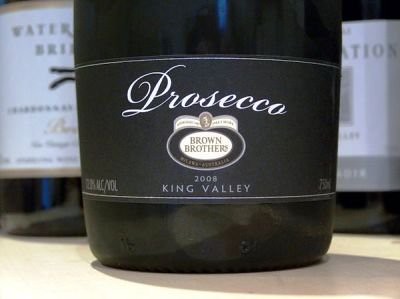
In a recent post on his blog Vino al vino, Franco Ziliani writes about Australian prosecco and Italian products being 'copied' overseas. At 26 comments and counting, a furore has ensued over what the Italians perceive as another episode in their beloved enogastronomic products being imitated around the world.
The more sensitive issue for Italians is not that overseas sources are copying their products, but that Italians themselves are incapable of properly protecting and promoting their culture and quality produce.
My take? Prosecco is a type of grape, so it is permissable that it be used in other wine making regions, Italy or overseas, and that it be given that name. For example, when, in Australia and the rest of the world, you could no longer say "Champagne", we were talking about a regional name and all the tradition and culture that lies behind that wine making technique. That does not mean we can no longer write "chardonnay" on a bottle of sparkling wine, it being the grape variety most used in that style of wine.
In addition, the Italians need to first learn to appreciate their own produce. Prosecco is one of the most bastardised words in wine in Italy, much like spumante, and many Italians drink "prosecco" as an aperitif without knowing what it is, whether that's what's really in the glass and whether it's of quality or not.
As pointed out in many of the comments on Vino al vino, the Italians need to devise a comprehensive system of protecting and promoting their own products. As one reader says, a wine tasting once a year of authentic Italian wine at the embassy in the US (and in any other country for that matter), does not constitute a concerted PR effort in the face of the many imitation Italian products that exist.
The argument is far more complex than I have been able to outline here, but it will be interesting to see if it becomes another example of intellectual property in the wine making world. For my part, I would be interested in trying the Brown Brothers prosecco, if only to taste an expression of this wine from another part of the world. That I would favour it over a good Italian prosecco from Valdobbiadene for all its tradition, culture and quality is another debate.
Monday, April 6, 2009
Wines from Slovenia: finding Pulec Wines at Vinitaly

The owner of Pulec wines happens to be a very nice man, and while his stand of wines from Slovenia at Vinitaly is nothing remarkable, it is worth a detour both for the welcome from the owner and the wines themselves.
Pulec wines is just across the border from Friuli-Venezia Giulia, Italy’s renowned white wine region of excellence. In addition, Pulec wines shares the same territory of the Collio DOC area of Friuli, which can be seen as a guarantee of quality.
Their wine range from Slovenia includes among the whites: friulano (formerly known as tocai friulano), ribolla gialla, pinot grigio and chardonnay, and for the reds: cabernet sauvignon and merlot.
I found the friulano (denominated sauvignonasse in Slovenia) and pinot grigio particularly impressive, with lovely intense perfumes and very soft in the palate. They are quite high in alcohol but should be great food matching wines. I also tried the cabernet sauvignon which was quite young, but showing excellent promise. It was full-bodied and tannic but its fruit and vegetable flavours should come to the fore in time.
Looking at the Pulec Wines gallery, you can see what a beautiful area they are in, with hillside terrain providing an ideal micro-climate. While the family still sells some of its grapes, they plan to increase their own bottling and labeling in time, with a new cellar that is currently on hold due to the economic downturn. Cellar visits in Slovenia are possible though.
Among the elbowing for space and the showing off of many visitors to Vinitaly, this was a truly unique and pleasant experience from a company proud of its traditions, and who believes in the quality and potential of its wines. I would say that if you’re looking for something different, Pulec Wines is definitely worth exploring.
Tuesday, March 17, 2009
Hunter Valley wine tourism: the good and the bad

On a recent holiday home to Australia with my boyfriend, we spent a couple of days in the Hunter Valley to introduce him to Australian countryside and get out of the city for a while.
I haven't been to the Hunter Valley for a long time, and it was fun to see how tourism, with its added touch of the appeal and sophistication of a wine producing areas, gets treated in regional NSW.
I've always been of the opinion that Australia knows how to do hospitality well, and I wasn't disappointed. We stayed at the Peppers Guest House retreat and had wonderful food at the Chez Pok restaurant, great surroundings and polite but friendly staff. The people we came across in the Hunter Valley were generally friendly but discreet and the Hunter provides plenty of the lovely countryside and peace and quiet we were looking for.
But when it came to wine tasting, I was disappointed. Firstly, all of the cellar doors are set up in such a way that wine producers fall into the trap of serving lots of wine to people who often know nothing about it, only to not make any sales.
Leaving aside discussions of responsible service of alcohol, we often found ourselves standing up at a kind up bar set-up, elbowing for room, while receiving patronising and offhand comments on the wines we were tasting.
At one producer, I find the quality of the wines impressive but difficult to determine as they were all served at room temperature - a problem when you're in the middle of the Australian summer. Another producer who has completely renovated their entire complex with highly sophisticated architecture and design, has their tasting room laid out such that there appeared to be a rugby match going on to fight for space.
Along with the extremely disappointing offer for that day (you can only taste from the list, and not choose generally from their range of wines), most of which was wine not even from the Hunter Valley, I was served by a screechy but bored woman with bright nail polish who subsequently told me that their Victorian riesling tasted just like a sauvignon blanc. Not a good comment to a customer who is undergoing sommelier training.
My advice to producers and customers would be to get to know each other, provide booked, private and guided tastings whereby the customer can really appreciate the story behind the company and quality of the wines. I would much prefer to sit down, be treated with some personal attention and really get to know a few wines, rather than scoffing many while standing in a throng of people trying to understand why one semillon is different from another. And I'd be far more likely to buy the wine too.
Photo | Flickr
Subscribe to:
Posts (Atom)