Friday, October 10, 2008

Perfumes in wine: how to learn a wine's bouquet, descriptions and a sommelier spice nose


The advice from our first lecturer in our sommeliers course is numerous and varied but one thing she said was that you can never identify a perfume if you can’t recognise it. She gave the example of an aromatic traminer and a group of teenagers that she once had to do a lesson with on wine tasting.

She had chosen traminer for the very fact that its aroma is unmistakable – it’s not called an aromatic grape for nothing. The students probably smelled wine and that’s about it, but one guy said “it smells just like lychees”. To say the audience was floored is to say little. But it was around Christmas time, lychees in Italy are in great supply and it happened to be his favourite fruit. Moral of the story? Know your perfumes.

What does this mean for an Australian in Italy learning wine tasting techniques? First of all, I need to gain some European knowledge, especially about plants. There are certain rules about wine tasting, one of which goes thus: white wine – white flowers and white fruit, red wine – red flowers and red fruit. Which is fine if you know your flowers.

My parents had a modest cottage garden in Australia when I was a child, but it soon evolved into something more native, and certainly didn’t include violets or peonies – just two of the flowers we’ve supposedly smelled in wines this week. My first step will be to learn the flowers in Italian. While some are similar, others are very different – hawthorn, for example, is called biancospino. My second step will be to start recognising the smell of these flowers, as I certainly don’t know what hawthorn should smell like, let alone recognise it in a glass of white wine.

I sometimes wonder if I said something smells like eucalyptus, whether that would be an acceptable and legitimate response. My resolution is to now discover the various wine perfume groups and their components. This will involve smelling and memorising various pices, herbal, vegetal, fruit, flowers, animal and ethereal components.

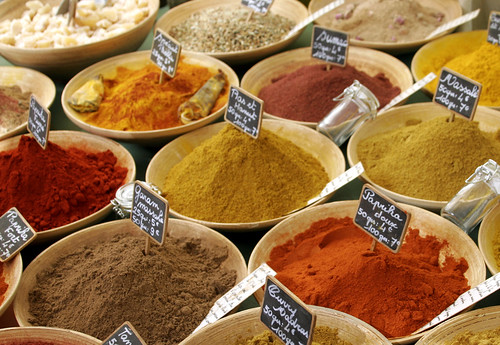
My first attempt has been unsuccessful as I entered a “drogheria” which is an old-style drug store in Italy, which sells spices, sweets, herbs, oils, salts and the like. I asked if they had a mixed confection of spices and they answered in the negative, saying they only sell various spices by weight. My plan was to sample and smell and memorise. After all I don’t smoke, and don’t really know what pure tobacco smells like. While I was tempted to buy something for home anyway – far more romantic than the jars of Ducros herbs and spices you get in the supermarket – I was somewhat disheartened and far too embarrassed to say I was on a research mission for my sommeliers course.

The flowers beckon, but I think I’m in for a tough challenge.

Photo | Flickr

Thursday, October 9, 2008

Italian wine and grape varieties: the indigenous Nero d'Avola


Our sommeliers course is coming along like a house on fire after only two lessons, but then given the second level is all about Italian wine and Italian wine making regions, the material is so rich it’s hard to get beyond just touching on each region.

The first lesson this week was a review of how to taste wine – the descriptions you can give, serious measurements of wine quality etc. The Italian Sommeliers Association has a list of parameters and measurements that include intensity, complexity, harmony, after-taste persistency etc etc. But more on that later.

This week we tasted a Nero d’Avola, and after my father asked me about this wine and its variety, I thought I’d give it some greater analysis myself. Nero d’Avola is a native Italian wine, and an indigenous grape variety of Sicily. It is a red wine and it happens to be one of my favourites (though nothing for me from the shores of Italy will ever beat nebbiolo).

We tasted Deliella’s version, which finished with 88 points for the nero d’avola. It’s a wine that costs about 40 euros at a wine shop and so on my buying a second sample this week (purely to consolidate our lessons, you understand) I unfortunately had to acquire a less expensive wine.

My second nero d’avola shares many of the characteristics of the first, with a little less complexity. I’m drinking it too young, but then it’s difficult to find an enoteca (Italian wine shop) that will have any vintage beyond recent ones.

Deliella’s wine was filled with a bouquet of spice mix – everything from cocoa to tobacco and some under brush in between. Our lecturer that evening said that nero d’avola has a perfume all of its own and is very distinctive when you learn to recognise it – the perfume she was referring to was a brackish, sea-salt air smell. To push your imaginations a little, she’s right. Even my cheaper variety had this aspect, so we’re at least a step towards recognising the variety in a blind tasting. I think it also has a green wood smell – like raw pine.

I have seen this Italian wine in Australia, which so far has gone under-appreciated in Italy itself. I think it could have an export future as it's closer to an Australian palate than some northern Italian wines I've tasted. For being snubbed a little in Italy, I’m not sure if it’s a perception that there is a lack of wine growing tradition in Sicily, or if it just suffers from being a southern wine, but this Italian variety is definitely worth looking out for. Just don’t drink it too young.

Tuesday, October 7, 2008

Wine courses in Italy: becoming a sommelier and wine tasting Italy's regions


Autumn is going to be a very busy season for me, full of wine tasting events, not to mention the second level of my sommelier course.

I completed the first level of the Italian Sommeliers’ Association course in 2007, which requires more effort than most wine tasting courses in Italy you’re likely to come across. The first is about wine tasting techniques – examining the look, smell and taste of wine and how to analyse it while also learning the language parameters to describe wine.

The introductory level also presents lessons on wine production, oenology, spirits and liqueurs, the role of the sommelier and Italian wine legislation, among other topics. It’s a broad introduction, but effective enough for those who then want to develop their knowledge and tasting technique.

Things are heating up in the second course which obviously presumes a far more evolved student in terms of their theory and wine tasting experience. It must be said this is still a course for amateurs, and probably not recommended for whoever wants to become a fully-fledged professional sommelier.

The second level presents Italy’s wine growing regions and its DOCG, DOC and IGT classifications in depth. In terms of wine tasting, it also introduces a points system to judge the overall quality of a wine, rather than limiting the taster to observations and wine description. This will likely have me brushing up on the vocabulary and theory from the first course before assigning any points anywhere, and could see me doing plenty of swirling and smelling at home.

The first lesson had reassured me about how much I haven’t forgotten (but thought I had) from the first course, but then I was gripped by panic about how much more I have to learn and my startling level of ignorance. But I got the coffee perfume right with the Nero d’Avola...let the challenge begin!

Sunday, October 5, 2008

Wine industry innovation: international exchanges in the wine sector

In Decanter’s September issue, Margaret Rand takes a look at the kind of exchanges that take place between the new world and old world of the wine industry.

I had a discussion with someone today, the nature of which made me question whether this constant dichotomy between new and old is helpful, but as it still exists and the wine industry is likely to continue down this split line, I’ll probably continue looking at things in this way, too.

The Decanter article was good because I think it highlights the point that I made in my last post – that Australia has a reputation for innovation in the wine industry. This is excellent for the Australian wine industry which, as I have said before, too often limits itself to a definition of quality for money (rather than just quality full stop).

The innovation goes beyond the use of screw caps and eye catching marketable labels. An interesting example came from Spain’s port-marking region and David Guimaraens, who went from Fonseca Port to Roseworthy Agricultural College to gain the empirical knowledge required to modernise the port making practices in his family business.

Another example, so pertinent in times where climate change is on everyone’s lips, was that of Philippe Guigal from the Rhone region in France, who was streaks ahead of his other wine maker counterparts during an extremely hot vintage. Harvest and racking and fermentation techniques to reduce the impact of a hot vintage were learned during his time in Australia and California.

But what about Australians travelling ‘back’ to the old world for an insight into how things are done in Europe..? The examples given here is exactly what is needed in these parts to show Europeans that Australian wine can compete with the best of them. The examples are what I needed in recent debates with a colleague over the use of chemicals and the lack of a ‘cru’ system in Australia (I will examine this topic at a later date because it was a particularly fascinating discussion we had).

Yalumba has perhaps pioneered the use and diffusion of the Viognier grape among Australian wine, and it learned this through a trip that Louisa Rose undertook to the Rhone. While she says that things weren’t that different in the Rhone, at least she was reassured that Yalumba was moving in the right direction.

The example I loved most was that of Vanya Cullen from Cullen Wines in the Margaret River, who is now employing bio-dynamic production in her vineyards. I am really impressed with the direction bio-dynamic wine making is taking, and the coverage it’s getting. Apparently it is one of the best ways to express terroir and I think Australia needs to get back in touch with its roots – that is to say that anything that increases the terroir expression of Australian wines, is a positive thing. The one thing that Cullen points out, that should be noted by anyone from Europe who thinks the new world lacks heritage and terroir, is that Australian soil is older than that in Europe. Bio-dynamics for Cullen, is all about risk taking for future sustainability. Climate change is again a key factor here.

While Decanter did the leg work on the article and provided some nice profiles, it didn’t really have a conclusive argument to make about the benefits to be had from these kinds of exchanges. I would hazard that they could prove to change the wine industry, both old and new, unfathomably.